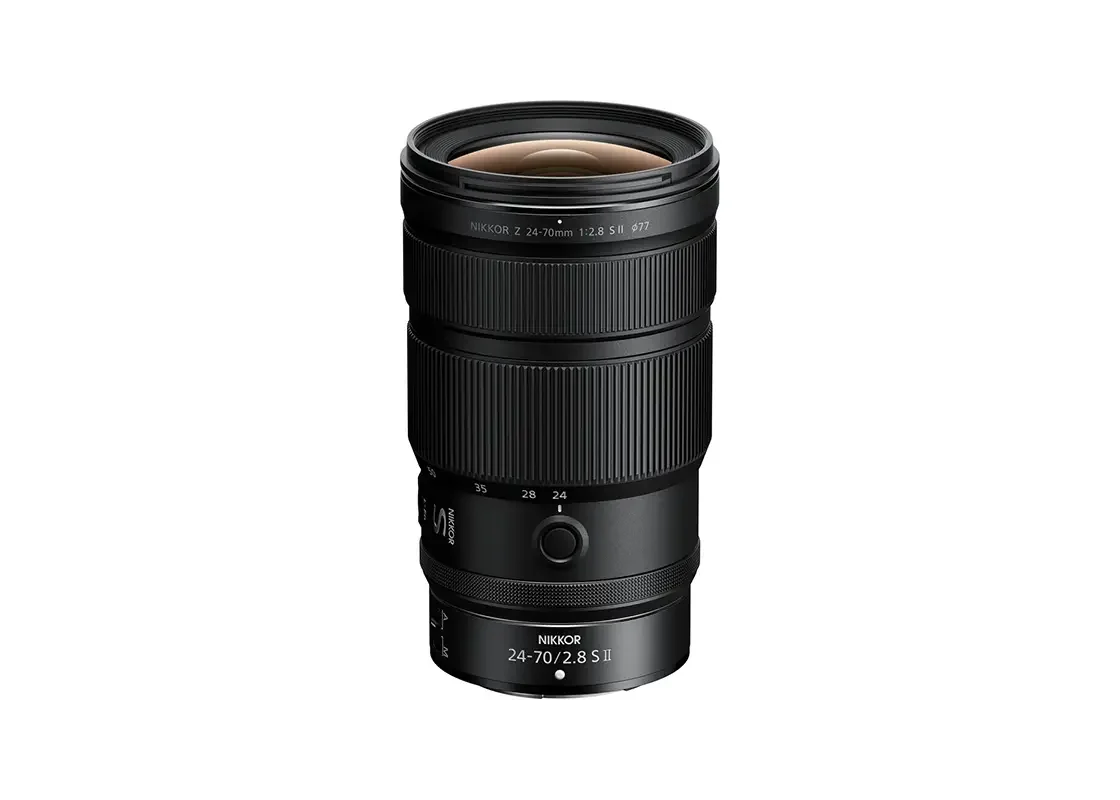
Rent the Nikon Z 24-70mm f/2.8 S II in Canada — the second generation of Nikon’s essential pro standard zoom, and the world’s first 24-70mm f/2.8 with an internal zoom design. Lighter, faster-focusing and better for video than the original, it’s the everyday workhorse for events, weddings, portraits, commercial and travel on Nikon Z. Key points:
- Constant f/2.8 across 24-70mm — the versatile focal range that covers most jobs in one lens
- World’s first internal-zoom 24-70mm f/2.8: the barrel never extends, improving balance, sealing and gimbal use
- About 16% lighter and shorter than the original, with a new, much faster and quieter autofocus motor
- 11 rounded aperture blades and a refined optical design for smoother bokeh and higher resolution
Our thoughts
The 24-70mm f/2.8 is the lens most pros keep on the camera, and this II version fixes the few things people wanted from the original. The internal zoom is the big one — it doesn’t change length, so it stays balanced on a gimbal, seals better against dust and moisture, and feels more planted. It’s also lighter, focuses noticeably faster and more quietly, and closes focus tighter. If you’re choosing between the two, the II is the clear upgrade for hybrid and run-and-gun work.
— Will, Founder
What’s changed vs the original 24-70mm f/2.8 S
- Internal zoom — the barrel no longer extends (a first for this class), versus the extending design of the original.
- Lighter & shorter — roughly 16% lighter (about 4.5 oz) and around 0.5″ shorter than the original when extended.
- Faster, quieter AF — new Silky Swift VCM motor: about 40% faster focus scans, 60% better focus tracking while zooming, and roughly twice as quiet.
- Smoother bokeh — 11 rounded blades (up from 9) and improved aspherical elements for a cleaner out-of-focus look.
- Closer focus — shortened minimum focusing distance (about 0.24m at 24mm, 0.33m at 70mm).
- Better for gimbals — centre-of-gravity shift reduced by around 30%, plus upgraded weather sealing.
Key specifications
| Lens mount |
Nikon Z |
| Format |
Full-frame (FX) |
| Focal length |
24–70mm |
| Maximum aperture |
f/2.8 (constant) |
| Minimum aperture |
f/22 |
| Aperture blades |
11 (rounded) |
| Optical design |
S-line, with 2 ED and 3 aspherical elements; ARNEO and Nano Crystal coats |
| Zoom design |
Internal zoom (non-extending) — a world first for 24-70mm f/2.8 |
| Autofocus |
Silky Swift VCM (SSVCM) — faster and quieter than the original |
| Minimum focus distance |
Approx. 0.24m (24mm) / 0.33m (70mm) |
| Filter thread |
82mm |
| Build |
Dust- and moisture-resistant; approx. 16% lighter than the original |
Compatibility & what you might add
- Fits any Nikon Z body — it’s the ideal everyday lens for full-frame Z cameras, and works on DX bodies with a roughly 36–105mm equivalent range.
- Takes 82mm screw-in filters — a polariser or ND is a useful pairing for outdoor and video work.
- The internal zoom makes it a strong choice on a gimbal — add one for stabilised video.
- Building a two-lens kit? Pair it with a 70-200mm f/2.8 from the Nikon Z lens range for full 24-200mm coverage at f/2.8.
Q&A
Should I choose the II over the original 24-70mm f/2.8 S?
For most people, yes. The II adds an internal zoom (so the lens doesn’t change length), is about 16% lighter and shorter, focuses roughly 40% faster and much more quietly, has smoother bokeh from 11 rounded blades, and focuses closer. The original is still a fine lens and optically excellent, but the II is the better all-round tool — especially for video and gimbal work. If you specifically want the II, make sure that’s what you book.
Why does the internal zoom matter?
Because the lens stays the same length as you zoom, three things improve: it stays balanced on a gimbal through the whole range, it seals better against dust and moisture, and the handling feels more stable. It also reduces the shift in centre of gravity by around 30% compared with the extending original — a real benefit for stabilised video.
What is it best for?
It’s the classic do-everything zoom. The 24-70mm range and constant f/2.8 handle events, weddings, portraits, editorial, travel and commercial work — wide enough for groups and interiors, long enough for flattering headshots, and bright enough for low light and background separation. For many shooters it’s the only lens they need on the camera most of the day.
Does it have image stabilisation?
There’s no VR built into the lens, so it relies on your camera’s in-body stabilisation. On modern Nikon Z bodies with IBIS that works well for handheld stills and video across this focal range.
What filter size does it take?
82mm — the same as the original 24-70mm f/2.8 S, so existing filters carry over. A circular polariser or ND filter pairs well; just let us know and we can add one to your rental.