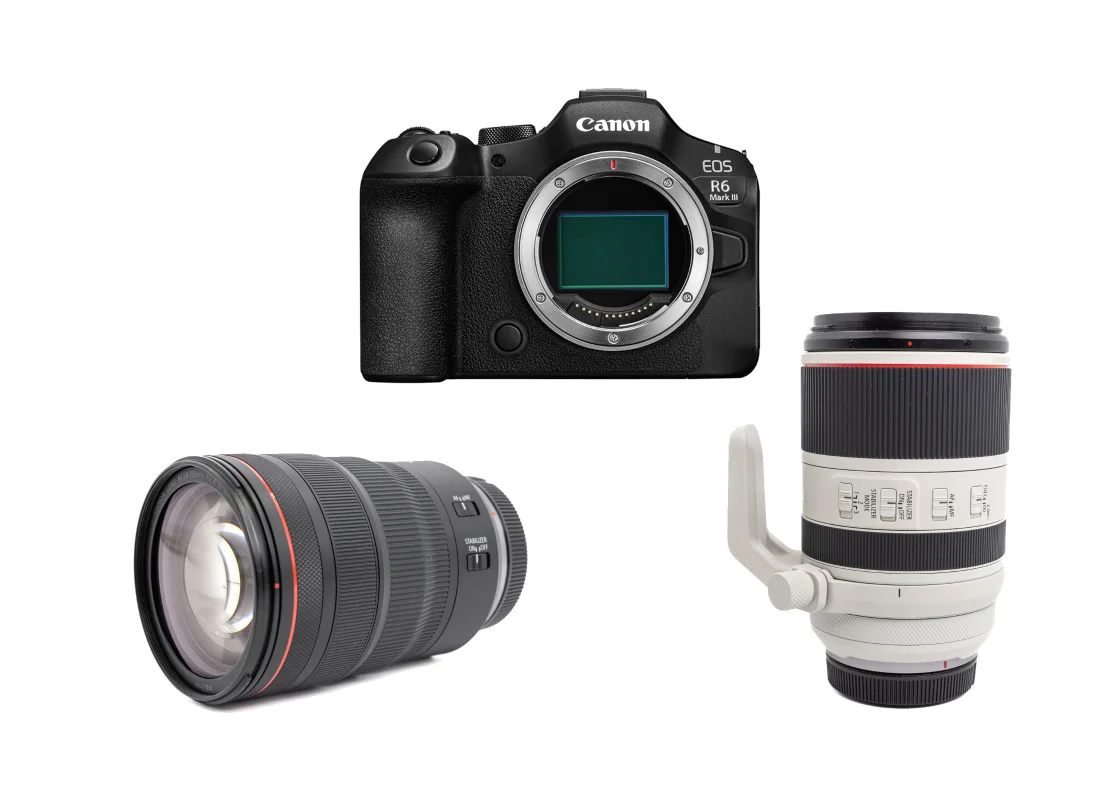
Rent the Wedding Photo Kit for Canon in Canada — the EOS R6 Mark III with the two f/2.8 zooms most wedding photographers build their day around, booked together in one order. The kit includes:
Kit showing as unavailable for your dates? That usually means one item in the kit is already booked — the rest may still be free. Check the R6 Mark III, RF 24-70mm and RF 70-200mm individually, book what’s available in one order, and we’ll pack it together. If one piece is out, ask us about an alternative.
Why this pairing works
- 24–200mm covered at a constant f/2.8 — prep, details and groups on the 24-70, ceremony and speeches on the 70-200
- 32.5MP back-illuminated sensor with up to 8.5 stops of in-body stabilisation for dim churches and evening receptions
- Dual Pixel CMOS AF II with eye and subject detection, plus Register People Priority to keep focus on the couple
- Silent electronic shutter at up to 40fps, so you can shoot through vows without the shutter clatter
Our thoughts
“This is the two-lens setup I’d take to almost any wedding. The 24-70 stays on the camera for most of the day and the 70-200 lets you work the ceremony from a respectful distance. Between the two lenses you can cover the whole day, from getting ready to the first dance.”
— Will, Founder
Key specifications
| Canon EOS R6 Mark III |
| Sensor |
32.5MP full-frame back-illuminated CMOS |
| Lens mount |
Canon RF |
| ISO range |
Photo: 100–64,000 (expandable to 102,400) |
| Autofocus |
Dual Pixel CMOS AF II, 1,053 zones; people, animal and vehicle detection; Register People Priority |
| Stabilisation |
5-axis in-body, up to 8.5 stops |
| Continuous shooting |
Up to 40fps (electronic) / 12fps (mechanical) |
| Video |
Open Gate 7K RAW up to 60p; 4K up to 120p, 10-bit, Canon Log 3 |
| Card slots |
CFexpress Type B + UHS-II SD |
| Viewfinder |
3.96M-dot OLED EVF, 0.76x |
| Screen |
3.0″ vari-angle touchscreen |
| Battery |
Canon LP-E6P |
| Weight |
Approx. 680g (with battery and card); weather-sealed |
| Canon RF 24-70mm f/2.8 L IS USM |
| Focal length |
24–70mm |
| Maximum aperture |
f/2.8 (constant) |
| Autofocus |
Nano USM with full-time manual override |
| Stabilisation |
Optical IS up to 5 stops |
| Minimum focus distance |
0.21m at 24mm; 0.38m at 70mm |
| Filter thread |
82mm |
| Weight |
Approx. 900g |
| Canon RF 70-200mm f/2.8 L IS USM |
| Focal length |
70–200mm |
| Maximum aperture |
f/2.8 (constant) |
| Autofocus |
Dual Nano USM with full-time manual override |
| Stabilisation |
Optical IS up to 5 stops |
| Minimum focus distance |
Approx. 0.7m |
| Zoom design |
Extends when zooming; compact when retracted |
| Filter thread |
77mm |
| Weight |
Approx. 1,070g |
Compatibility & what you might add
Q&A
The kit says unavailable — can I still get this gear?
Probably. A kit only shows as available when every item in it is free, so one booked lens is enough to block it. Check the R6 Mark III, RF 24-70mm and RF 70-200mm listings separately, book the pieces that are free, and get in touch if you need a substitute for the one that isn’t.
Can I back up to two cards during the day?
Yes. The R6 III has one CFexpress Type B slot and one UHS-II SD slot, and can write every image to both at once. The kit includes the CFexpress card; add an SD card to your order for the backup slot. For a wedding, it’s worth doing.
Will it cope in a dark church or reception?
Well. Both lenses stay at f/2.8 across their range, the R6 III’s sensor holds up cleanly at high ISO, and in-body stabilisation lets you use slower shutter speeds for still subjects. For very dark venues, a fast f/1.2 prime or a flash gives you more room.
Can I shoot silently during the ceremony?
Yes — switch to the electronic shutter and the camera makes no shutter sound. Under some LED or fluorescent lighting you may see banding with the electronic shutter; if so, switch to electronic first curtain, which is still very quiet.
Do I need a second camera body?
Not always, but many wedding photographers run two — one with each zoom — so they never miss a moment changing lenses. If you’re the only shooter, adding an R6 Mark II is the simplest way to do it.